

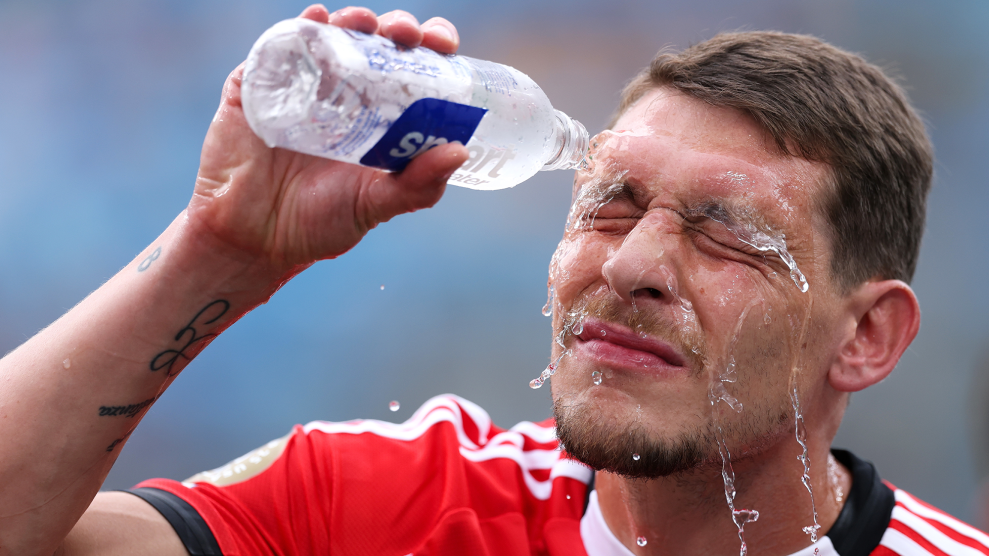
World Cup 2026 is being played in a North American summer that climate scientists say could make it the hottest World Cup yet, with roughly a quarter of matches expected to be played in very hot conditions. For anyone who watches full games and cares about tactics and performance trends, understanding how heat and humidity interact with pressing, tempo and decision‑making is essential to interpreting what you see rather than just blaming or praising “effort.”
Why Heat And Humidity Are A Real Tactical Factor
Meteorologists and climate researchers estimate that around 25% of the tournament’s 104 matches could take place in conditions where the Wet Bulb Globe Temperature (WBGT)—a measure combining temperature, humidity, sun and wind—reaches at least 26°C, with some fixtures pushing into the high‑risk zone near or above 28°C WBGT. Cities such as Houston, Dallas, Miami and Monterrey are highlighted as particular trouble spots because high humidity slows the evaporation of sweat, making it harder for players to cool themselves even at similar air temperatures.
On the pitch, that means the same pressing model that looks sustainable in Vancouver or Toronto may be impossible to maintain for 90 minutes in a humid afternoon game in Texas or northern Mexico. When you watch matches from hotter venues, it helps to assume that coaches are managing a finite “intensity budget”: they decide when to press high, when to drop the block, and when to slow the game not just for tactical reasons but to prevent heat‑driven collapse later in the tournament.
Physiology: How Heat Changes What Players Can Do
Sports scientists analysing the 2026 host cities note that heat stress from high humidity, solar radiation and low wind can quickly raise core body temperature and force the body into overdrive to keep it stable. The basic mechanism is familiar: the body sweats to cool itself, but in humid air sweat evaporates more slowly, so players stay wetter without losing much heat, leading to dehydration, cramps and earlier fatigue.
At match level, that shows up in a few recurring patterns: total high‑intensity running distances drop, repeated‑sprint ability declines, and technical execution—first touch, final‑third decision‑making—deteriorates faster as players tire. As you watch, it is useful to connect late‑game miscues or “unforced” defensive errors not only to pressure or nerves but to cumulative heat load, especially in matches flagged beforehand as high‑risk by meteorologists and player‑welfare groups.
What To Look For When You ดูบอลสด In Hot-Humid Matches
When you ดูบอลสด from one of the hotter World Cup 2026 venues, you can read heat and humidity into specific on‑pitch behaviours rather than treating them as abstract background. Hydration breaks—now mandated three minutes into each half in every match, regardless of conditions—give you natural checkpoints to see how tired players look and how coaches adjust pressing or shape immediately afterwards. In very humid games, you will often see sides use these pauses to huddle, tweak line height and plan when to “spend” their next aggressive press.
You can also watch for subtle time‑wasting or tempo‑control techniques that are more about survival than cynicism: centre‑backs holding the ball an extra second before circulating, goalkeepers taking full advantage of the new eight‑second limit before releasing, or teams choosing shorter, lower‑risk passes instead of vertical ดูบอลโลก 2026 วันนี้ กับ Goaldaddy.s that would stretch the game. Over 90 minutes, those choices reshape xG and shot patterns: you may see fewer long counter‑attacks but more deliberate possessions ending in medium‑quality shots, reflecting a conscious trade‑off between chance quality and energy conservation.
Which Cities Pose The Biggest Heat-Stress Challenges?
Studies of the 16 host cities use indices such as WBGT and Universal Thermal Climate Index (UTCI) to estimate how oppressive conditions could be in June and July. Six cities—Miami, Houston, Dallas, Monterrey, Kansas City and Atlanta—are repeatedly flagged as venues where WBGT can feasibly reach or exceed 32°C (around 90°F), a threshold at which FIFA guidelines consider heat‑illness risk to be extreme.
By contrast, Canadian cities like Vancouver and Toronto, and some Pacific coast venues, are projected to be relatively milder, with average highs closer to the high‑70s or low‑80s Fahrenheit and lower humidity. When you compare performances across the tournament, it is worth adjusting your expectations: a flat, low‑tempo showing in a Houston mid‑afternoon group game may say less about a team’s overarching quality than how they adapt when the climate pushes them away from their ideal playing style.
H3: Sample Heat Risk Across Selected Host Cities
| City | Typical June–July conditions and risk profile |
| Miami | Hot, very humid, feels hotter than air temp; high WBGT, frequent storms. |
| Houston | High temps in 30s°C, high humidity; among highest heat‑stress risks. |
| Dallas | Upper‑80s to 90s°F, strong sun; high UTCI estimates. |
| Monterrey | Hot, often humid; flagged as a key heat hotspot. |
| Kansas City | Can reach high WBGT on still, sunny days. |
| Vancouver | Cooler coastal climate; lower heat‑stress baseline. |
Seeing this spread helps explain why the same team might look tactically dominant in one city and strangely passive in another a few days later.
How Heat Alters Pressing, Blocks And Game States
From a tactical standpoint, extreme heat pushes coaches to tweak three main levers: how high they press, how aggressively they counter‑press, and how much space they accept behind their defensive line. Analysts warn that the classic all‑game high press is rarely viable in the most humid venues; the risk is not just tired legs but heat‑induced cognitive drops that lead to missed cues and catastrophic spacing.
Instead, you may see teams choose more compact mid‑blocks, pressing only on specific triggers—back‑passes, heavy touches, or predictable wide build‑up—to concentrate effort. In possession, heat can nudge teams toward slower circulation and fewer direct, transitional attacks, because every long sprint carries a heavier physiological cost. When you watch, comparing a team’s PPDA (passes per defensive action) or visible pressing cues between cooler and hotter matches is a good way to see how much climate has forced them off their ideal tactical script.
FIFA’s Cooling Breaks And Player-Safety Measures
FIFA and medical experts have responded to these projections with a mix of scheduling tweaks and in‑match safeguards. Heat‑risk assessments have led to adjusted kick‑off times for some fixtures, moving games out of the absolute peak afternoon heat in high‑risk cities. On the pitch, there are now automatic three‑minute hydration breaks midway through each half in every match, plus provisions for extended breaks or additional measures if WBGT readings move near or above 32°C.
Teams also make heavier use of cooling vests, ice towels, shaded benches and heat‑acclimation training camps in the build‑up to the tournament. For viewers, the key is to see these not as interruptions but as structural parts of the match: hydration breaks and longer half‑time routines are moments where coaches can reset shape and instructions, meaning tactical shifts may coincide with these pauses more often than in cooler tournaments.
Where The Concept Can Mislead: Small Samples And Outlier Performances
While heat and humidity clearly matter, there is a risk of over‑attributing every dip in intensity to climate alone. Some scientists have criticised FIFA’s current heat‑safety measures as “inadequate,” arguing that worker and player protections still lag behind best practice. Yet even they stress that individual responses vary: some players and teams handle heat well, others struggle more, and small‑sample performances can be misleading.
When you evaluate a side’s overall level, it is better to look across multiple matches in different cities rather than drawing firm conclusions from one sluggish display in a hot, humid afternoon kick‑off. A team that shows coherent structure and consistent xG over four or five games, but has one outlier in extreme heat, is probably still tactically sound; one that repeatedly fades late in hot games despite rotation might have deeper conditioning or depth issues that will matter in the knockouts.
Summary
Heat and humidity at World Cup 2026 are not side stories; they are central conditions that will shape pressing, tempo, technical execution and even substitution timing across roughly a quarter of the tournament’s 104 matches. By considering city‑specific climate risks, watching how teams use hydration breaks and reading tactical choices through the lens of limited “intensity budgets,” you can judge performances more fairly and understand when a flat second half reflects tactical weakness—and when it is simply the game bending to the North American summer.