

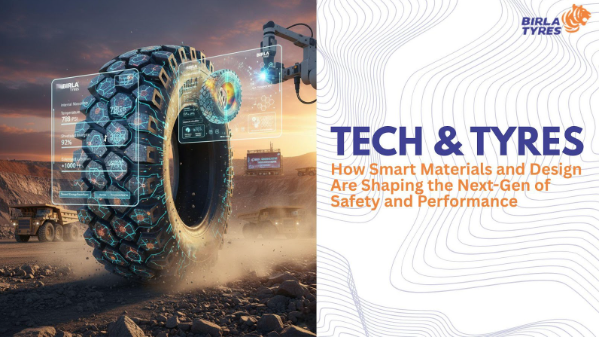
For decades, vehicle owners have seen tyres as consumable rubber rings. An essential component of a vehicle, but seen as a passive component that comes in different types and sizes for different vehicles.
However, that outlook is drastically changing with the introduction of new tyres, especially in the heavy-duty vehicle segment. A surge of quiet revolution has been underway, transforming tyres into adaptive, self-sustaining systems that do more than let a vehicle roll on the ground.
It provides traction, comfort, and most importantly, safety through the inclusion of innovative technologies. Intelligent tyres with smart, adaptive technology and self-sustaining systems are trending. Where safety and efficiency on road and off-road are non-negotiable, these tyres are now solutions.
Commercial freight fleets, mining vehicles, agricultural vehicles, construction vehicles, and port machines are making the most out of these innovations. We have dived into the innovative smart materials and intelligent designs that are driving change in the off-highway tyre segment. So, keep reading.
The Rise of Smart Tyres
Innovative tyre foundations, new compounds, designs, and treads researched by Birla Tyres’ R&D team promote the rise of smart tyres, especially for truck bias tyres.
Let’s discuss some smart tyre features shaping the future of commercial tyres in India:
- Durability: Improved resistance to wear and tear.
- Retreadability: Extends the life cycle of nylon bias tyres.
- Load-bearing capacity: Especially useful for heavy-duty commercial applications.
You can witness a predominant use of this proprietary tyre technology in Birla’s Ultra Miler Platina, and Kalapatthar series, used mainly in industrial applications.
Birla Tyres has also invested in polymer grafting and sustainable compound formulation technology. The former adds to the quality of traction, that’s usually most helpful in agricultural tyres. Meanwhile, the latter promotes sustainability by diminishing the environmental impact.
You will find these proprietary and innovative tyre technologies in Shaan+, Super+ and Farm Haul Platina series by Birla Tyres.
Advanced Compounds for Better Grip
IoT (Internet of Things) sensors and smart gadgets aside, innovators have also placed significant focus on the materials used in creating tyres. Modern tyres are evolving beyond traditional carbon black and petroleum-based rubber compounds.
Thanks to this innovation, heavy-duty construction or agricultural vehicles enjoy better grip on muddy fields and in extreme driving conditions. Chances of accidents and difficulty on the road are significantly reduced thanks to this.
Digital Simulation Tools Improve Tyre Quality and Performance
Birla Tyres is now investing in digital simulation tools, including the likes of CATIA, HyperMesh, and Abaqus. These technologies are advanced means to create proprietary tread patterns that you can witness in the tyre series manufactured exclusively by Birla Tyres.
The three tools can also successfully optimize mould cavity design and offer more predictability about tyre performance to drivers. The incorporation of these technologies results in higher mileage, better cut resistance, and balanced on and off-road performance.
Impact across Heavy-Duty, Mining & Agriculture Vehicle Segments
The innovations in the tyre manufacturing industry have had a significant impact, especially in the three vehicle segments—construction, commercial transport, and Agriculture.
Construction: Tyres for construction vehicles must survive unpredictable terrains. Rocks, nails, and debris are common obstacles these tyres deal with. The Use of smart and new components for the tyres would definitely build endurance against common hazards for construction tyres.
Technology like nano silica compounds extends tyre life, combats hazards, improves load-bearing capacity, and enhances resistance to wear and tear at construction sites.
Commercial Transport: Predictive maintenance features, enabled by the integration of smart sensors in tyres, have also marked a breakthrough for commercial transport vehicles.
Long-haul trucking fleets and logistics companies can also leverage AI-enabled software that analyzes data transmitted directly from the tyre. The result? Better understanding of tyre health, durability of the tread compounds, and techniques to improve safety and mileage.
Agriculture: Farming equipment demands tyres capable of navigating wet soil, resisting punctures during plowing, and carrying massive loads without failures. Compounds with self-healing elastomers and sustainable rubber sources elevates performance here.
Across all segments, these innovations reduce downtime, extend tyre lifecycles, and enable smooth, safe operation in demanding conditions.
Future Outlook: AI and Autonomy
Tyres are no longer a ring of black rubber meeting the road. These tools enhance performance and safety, enabling fleets to operate uninterrupted journeys. Looking forward, innovations and tech integrations are underway.
The integration of artificial intelligence with thousands of connected vehicles and their tyres will enable the derivation of predictive analytics about tyre health, warning drivers before accidents could occur. It’ll become easier to assess load profiles and environmental conditions through tyres.
As autonomous driving advances, smart tyres are acting as a critical sensory node feeding vital data to the vehicle’s AI systems to optimize stability, grip, and braking in real time.
A combination of these new breakthrough technologies and smart materials prepares a new era for efficient and higher-performing tyres. This leap of innovation signifies the beginning of a new era for various types of vehicles.