

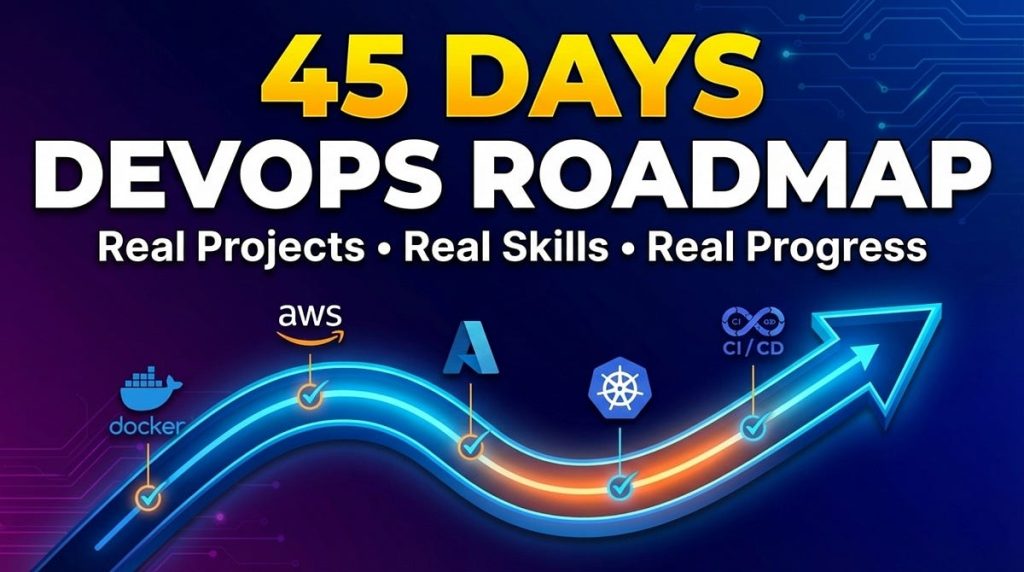
DevOps is often marketed as a fast track into high-paying tech roles. Phrases like “DevOps in 3 months” or “Become a DevOps engineer quickly” create a dangerous expectation—especially for freshers and career switchers. When learners struggle, they assume something is wrong with them.
In reality, DevOps is not a race. It’s a journey that requires direction.
DevOps is a broad, interconnected discipline that combines systems, automation, cloud, collaboration, and problem-solving. Trying to rush through it without a roadmap leads to confusion, burnout, and loss of confidence. What truly makes DevOps achievable is structure, sequencing, and disciplined execution.
A structured online Devops course provides that direction. It lays out a clear roadmap—from Linux and networking to cloud platforms, CI/CD pipelines, containers, and automation. Combined with disciplined Devops training, this roadmap transforms freshers from overwhelmed learners into confident, job-ready engineers.
This article explores that journey in depth: why DevOps feels overwhelming, why direction matters more than speed, how a structured roadmap works, how disciplined training builds confidence, and why projects—not theory—turn interviews into conversations.
1. Why DevOps Feels Overwhelming to Beginners
DevOps is not one skill. It is an ecosystem of skills working together. Beginners often underestimate this and jump in with unrealistic expectations.
1.1 The Breadth of DevOps
DevOps touches:
- Operating systems (Linux)
- Networking fundamentals
- Version control (Git)
- CI/CD pipelines
- Cloud platforms
- Infrastructure automation
- Containers and orchestration
- Monitoring, security, and reliability
Each of these areas could be a career on its own. When beginners see this list, panic sets in.
1.2 The Internet Makes It Worse
Online content rarely explains how these pieces fit together. Instead, learners see:
- “Top DevOps tools to learn”
- “Master Kubernetes now”
- “Terraform is mandatory”
This creates the illusion that DevOps is about collecting tools quickly. Learners rush, skip fundamentals, and feel lost when things stop working.
The problem is not DevOps.
The problem is lack of direction.
2. Why DevOps Is Not a Race
In many careers, speed matters. In DevOps, direction matters more than speed.
2.1 Fast Learning Without Direction Fails
Learning fast without structure leads to:
- Shallow understanding
- Fragile confidence
- Inability to troubleshoot
- Interview anxiety
Learners might “finish” tools but cannot explain:
- Why a pipeline failed
- How traffic reaches an application
- What happens when a server crashes
2.2 DevOps Rewards Depth, Not Hurry
DevOps engineers are trusted with:
- Production systems
- Customer-facing applications
- Business-critical infrastructure
Companies don’t want fast learners who break systems.
They want reliable engineers who understand what they’re doing.
3. The Importance of Direction in DevOps Learning
Direction answers three critical questions:
- What should I learn?
- In what order?
- When am I job-ready?
Without direction, learners drift. With direction, progress becomes predictable.
A structured online DevOps course provides this direction.
4. What a Structured DevOps Roadmap Looks Like
A real DevOps roadmap mirrors how systems are built and operated in the real world. It is not random. It is layered.
5. Step 1: Linux – The Foundation of DevOps
Linux is not optional in DevOps. It is the foundation.
5.1 Why Linux Comes First
Cloud servers, containers, CI/CD agents, and Kubernetes nodes all run on Linux. Without Linux fundamentals:
- Cloud feels magical
- Errors feel mysterious
- Troubleshooting becomes guesswork
5.2 What Learners Actually Need From Linux
Not everything—only what matters:
- File systems
- Processes
- Permissions
- Services
- Logs
- Basic performance troubleshooting
A structured roadmap ensures learners build confidence in Linux early, reducing fear later.
6. Step 2: Networking – Understanding How Systems Talk
Many DevOps issues are networking issues in disguise.
6.1 Why Networking Is Introduced Early
Before cloud and CI/CD, learners must understand:
- IP addresses
- Ports
- DNS
- Load balancing
- Firewalls
Without networking, learners cannot explain:
- Why an app is unreachable
- Why a deployment “works locally” but fails in cloud
- Why latency occurs
A structured online DevOps course introduces networking before cloud to avoid confusion.
7. Step 3: Git – The Backbone of DevOps Workflows
DevOps workflows revolve around code—even infrastructure code.
7.1 Why Git Comes Before CI/CD
CI/CD pipelines automate changes stored in Git. Without Git fundamentals:
- Pipelines feel abstract
- Merge conflicts confuse learners
- Collaboration becomes difficult
Structured DevOps training ensures Git is understood as a collaboration tool, not just a command set.
8. Step 4: CI/CD – Automating the Flow of Change
CI/CD is where DevOps begins to feel real.
8.1 CI/CD as a System, Not a Tool
A pipeline is not a script. It is a system that:
- Validates changes
- Builds artifacts
- Deploys applications
- Prevents errors from reaching users
Learners with strong fundamentals can understand:
- Why pipelines fail
- How to design rollback strategies
- How automation reduces risk
9. Step 5: Cloud – Infrastructure With Context
Cloud platforms are often taught too early. This overwhelms beginners.
9.1 Why Cloud Comes After Fundamentals
Cloud concepts make sense only when learners understand:
- Servers (Linux)
- Networking
- Automation basics
A structured roadmap introduces cloud as an extension of existing knowledge, not a brand-new mystery.
10. Step 6: Containers – Packaging Applications Properly
Containers solve specific problems:
- Dependency conflicts
- Environment inconsistency
- Deployment reliability
10.1 Docker Before Kubernetes
Docker teaches:
- Process isolation
- Resource limits
- Application packaging
Without Docker, Kubernetes feels impossible.
11. Step 7: Kubernetes – Managing Complexity at Scale
Kubernetes is not for beginners—but it becomes logical when introduced at the right time.
A structured roadmap ensures learners:
- Understand why Kubernetes exists
- Can reason about failures
- Don’t treat it as magic
12. Step 8: Automation & Infrastructure as Code
Automation is not about speed—it’s about consistency and safety.
Learners trained with structure understand:
- Why automation prevents errors
- How versioned infrastructure improves reliability
- When automation can be dangerous
13. Step 9: Monitoring, Reliability, and Incident Thinking
DevOps is incomplete without feedback.
Structured DevOps training introduces:
- Metrics
- Logs
- Alerts
- Incident response basics
This prepares learners for real jobs, not just demos.
14. Why Freshers Feel Overwhelmed Without Structure
Freshers struggle because:
- They don’t know what matters
- They compare themselves to others
- They chase tools instead of understanding
A roadmap removes this mental burden.
15. How Disciplined DevOps Training Changes Everything
Discipline means:
- Practicing consistently
- Rebuilding systems
- Fixing failures
- Writing explanations
This turns learning into skill.
16. From Overwhelm to Confidence
Confidence grows when:
- Systems make sense
- Errors become solvable
- Progress is visible
Structured training accelerates this transformation.
17. Why Projects Replace Theory
Theory explains what.
Projects prove can you do it.
17.1 What Real Projects Do
Projects:
- Connect concepts
- Reveal gaps
- Build confidence
- Prepare interview stories
A strong online DevOps course emphasizes projects over lectures.
18. Interviews as Conversations, Not Interrogations
When learners rely on theory:
- Interviews feel scary
- Answers feel memorized
- Confidence collapses
When learners rely on projects:
- Interviews become discussions
- Answers are experience-based
- Confidence is natural
19. How Recruiters Evaluate Freshers
Recruiters don’t expect perfection. They look for:
- Clear thinking
- Honest explanations
- Learning mindset
- Practical exposure
Structured DevOps training aligns perfectly with this.
20. Why the Right Roadmap Saves Time
Rushing wastes time.
Restarting wastes time.
Confusion wastes time.
Structure saves time.
21. DevOps Careers Are Built, Not Cracked
DevOps is not an exam to crack.
It is a career to build.
Roadmaps build careers.
22. Why Consistency Beats Talent in DevOps
Talent fades under pressure.
Consistency compounds over time.
DevOps rewards those who keep showing up.
23. The Long-Term Advantage of Structured Learning
Engineers trained with structure:
- Adapt faster to new tools
- Grow into senior roles
- Handle responsibility better
24. Why Shortcuts Don’t Work in DevOps
There are no shortcuts to:
- Systems understanding
- Reliability
- Trust
Structure is not a shortcut—it is the correct path.
25. Reframing the DevOps Journey
Stop asking:
- “How fast can I learn DevOps?”
Start asking:
- “Am I following the right direction?”
26. The Emotional Side of the Journey
Structure reduces:
- Anxiety
- Self-doubt
- Comparison
Confidence grows quietly.
27. Why the Right Online DevOps Course Matters
A good course:
- Respects learning curves
- Builds foundations
- Emphasizes execution
- Prepares for real jobs
A bad course overwhelms and discourages.
28. What Makes DevOps Achievable
DevOps becomes achievable when:
- Learning is sequenced
- Practice is consistent
- Progress is visible
29. The Difference Between Trying and Progressing
Trying feels exhausting.
Progress feels motivating.
Structure converts trying into progress.
30. Final Perspective: Direction Over Speed
DevOps is not a race. It’s a journey that requires direction. A structured online DevOps course provides a clear roadmap—from Linux and networking to cloud, CI/CD, and automation.
With disciplined DevOps training, freshers stop feeling overwhelmed and start building confidence. Projects replace theory, and interviews become conversations instead of interrogations.
The right roadmap doesn’t make DevOps easy—but it makes it achievable.
And in DevOps, achievable is what leads to real careers, long-term growth, and genuine confidence.