

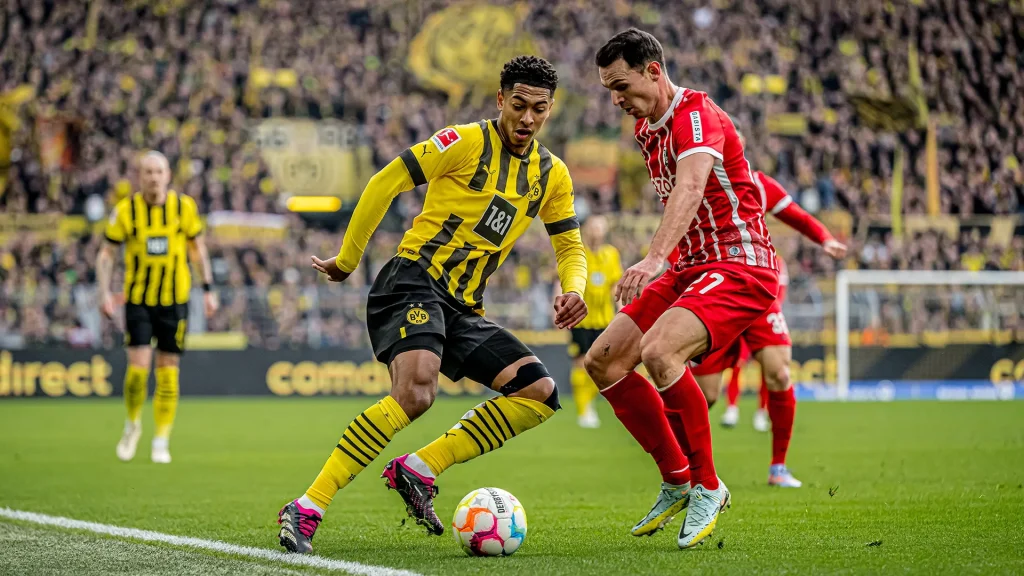
Talking about Bundesliga teams that “often pass the ball into the final third” really means identifying sides whose entire attacking identity is built on progressing possession up the pitch through structured passing, not just occasional long balls. This behaviour shows up in high volumes of final‑third entries, progressive passes and territorial dominance, but it does not always translate directly into goals.
What counts as a “final-third passing team” in Bundesliga data
In analytic terms, final‑third focus is captured by metrics such as final‑third entries per 90, progressive passes, passes into the penalty area and field-tilt (share of passes in the attacking half). Bundesliga stat packages show that top possession sides—Bayern, Leverkusen, Leipzig and Dortmund—sit near the top for all of these, combining high pass counts with a large share aimed into advanced zones.
FootyStats’ and Bundesliga.com’s territorial stats confirm that these clubs spend more time in the opponent’s half than league averages and attempt more progressive actions, which naturally raises their raw count of passes into the final third. The underlying idea is that they try to control games by repeatedly moving the ball into dangerous areas rather than waiting for transitions.
Structural reasons some clubs reach the final third so often
Teams that live in the final third are generally built for possession and controlled pressure. Bayern, Leverkusen and Leipzig assemble midfields full of press‑resistant passers and mobile 8s who can step between lines, while their full‑backs or wing‑backs stretch horizontally to open passing lanes. The cause–effect chain is straightforward: better technical quality and positional spacing make it easier to progress the ball methodically through each line.
Another structural factor is aggressive counterpressing. Sides that win the ball back quickly after losing it regain possession closer to the opponent’s box, reducing the distance to the final third and enabling repeated entries. Bundesliga’s high‑press culture, especially among the top four or five clubs, means that for them, final‑third passing is not only a product of build‑up but also of where they recover the ball.
Tactical patterns of teams that rely on final-third circulation
Once in the final third, these teams rarely rush the first available cross. Instead, they circulate the ball across the width of the pitch, probing for openings through half-spaces and full‑back overlaps. Passing networks for Bayern and Leverkusen show dense connections between attacking midfielders, wide players and full‑backs in advanced areas, reflecting a deliberate strategy of repeated entries and recycling rather than one‑off punches.
This approach has two key outcomes. First, it increases the probability of eventually finding a high‑quality shooting lane or a cut‑back, because defenders are shifted side to side until they make errors. Second, it pushes opponents deep and compresses them around their own box, allowing the attacking team to keep waves of pressure and maintain territorial advantage even if individual moves break down.
Comparing vertical-transition sides with final-third-possession models
Vertical-transition teams—often mid-table or lower—aim to move from regain to box as fast as possible, with fewer passes and more direct balls into space. Their final‑third pass counts can be modest even when they create good chances because attacks are short and high‑impact.
Final‑third-possession models, by contrast, accept longer attacks and higher pass volume. Their possession chains frequently cross the line into the final third multiple times before a shot appears. Statistically, this yields many final‑third entries and passes into the box, but with varying levels of shot volume and xG depending on how sharp their last‑pass and finishing mechanics are.
How frequent final-third passing impacts chance creation and control
Frequent final‑third entries are strongly correlated with territorial dominance and shot volume, but the relationship is not one-to-one. Bayern and Leverkusen pair high final‑third passing counts with top-tier xG and goals because their patterns consistently generate central shots and clear cut‑backs. Some other high‑entry sides, however, see more of their passes end in wide crosses or blocked attempts, which inflates volume without equally raising expected goals.
The main impact of sustained final‑third passing is game control. Teams that keep the ball close to the opponent’s box limit counter-attacking opportunities and dictate tempo. Even when they do not score early, they force opponents into long defensive shifts, increasing the chance that fatigue or concentration lapses eventually create openings.
Using final-third passing profiles in applied pre-match thinking with UFABET
From an educational pre-match analysis standpoint, understanding which Bundesliga teams regularly pass into the final third helps frame expectations about territory, shot counts and potential pressure patterns. When reviewing fixtures through a football betting website or similar platform during decision-making on ufabet168 wallet เข้าสู่ระบบ, a practical first step is to check which side normally dominates progressive passes and final‑third entries—typically Bayern, Leverkusen, Leipzig or Dortmund. Against low-block opponents, these teams are structurally more likely to pin rivals back and accumulate high attack counts; against other high‑press sides, their ability to reach the final third can be more contested, with turnovers and transitions playing a larger role. Recognising these profiles helps avoid overrating underdogs’ territorial chances in matches where the structure almost guarantees that elite possession teams will camp near their box for long spells.
List: Practical steps to identify high final-third passing Bundesliga teams
Because raw possession numbers can hide where the ball is actually played, a small sequence helps separate genuine final‑third specialists from teams that mostly circulate in safer zones. The goal is to connect progression metrics with how attacks actually reach dangerous areas.
- Start with progressive-pass and final‑third-entry stats: note which teams consistently rank in the top tier for passes into the attacking third and into the penalty area.
- Cross-check with field-tilt or attacking-half possession: ensure that high overall possession is actually spent in advanced zones rather than endlessly across the back line.
- Look at shot maps and xG distributions: see whether final‑third passes translate into box shots and central chances or mostly into low-value wide crosses.
- Examine assist and key-pass leaders: sides with multiple attackers near the top of key-pass charts, like Bayern, Leverkusen and Leipzig, usually have coherent final‑third structures, not just volume.
- Finally, review match footage or extended highlights for a small sample: confirm whether the team genuinely builds sustained pressure in the final third or only reaches it sporadically through transitions.
Following this routine turns a broad label—“they always get into the final third”—into a grounded observation based on progression volume, territorial share and chance quality. It separates teams that truly live around the opponent’s box from those whose final‑third entries are occasional and chaotic.
Table: Typical Bundesliga profiles based on final-third passing
Different Bundesliga teams use final‑third passing in different ways. The table below sketches common profiles and their main implications.
| Profile type | Final-third passing traits | Typical impact on matches |
| Elite possession-dominant (Bayern / Leverkusen-type) | Very high entries and passes into box; strong xG per game | Territorial dominance, many chances, sustained pressure |
| Structured high-possession (Leipzig / Dortmund-type) | High entries, many half-space connections, good but slightly lower xG | Strong control; frequent chances, sometimes wasteful finishing |
| Mixed model, transition-capable | Moderate entries; balance of build-up and counters | Games swing between sustained attacks and fast breaks |
| Deep-block & counter | Low final-third pass counts; rely on few vertical entries | Few sustained attacks; depend on transitions and set pieces |
Teams in the first row combine frequent final‑third passes with efficient chance creation, making their territorial statistics directly relevant to goal expectations. Those in the second row also dominate zones but may suffer more from finishing variance. Sides in the fourth row can appear weak in progression metrics but still be dangerous in specific situations; their low final‑third pass numbers mostly indicate how they choose to play, not necessarily a lack of threat.
Summary
Bundesliga teams that frequently play the ball into the final third are typically the league’s structured, possession-focused sides, whose attacking identities revolve around repeated progression and sustained pressure near the opponent’s box. Bayern, Leverkusen, Leipzig and Dortmund stand out in progression and territorial stats, using high technical quality and pressing to ensure that much of their passing occurs in advanced zones.
Seeing final‑third passing as a structural trait rather than a mere statistic clarifies why some teams spend entire matches camped around the opponent’s area while others rely on sporadic breaks. Read in context—alongside xG, shot maps and tactical profiles—it becomes a practical tool for anticipating where the ball will live in a given Bundesliga fixture and which side is more likely to dictate territory and tempo.