

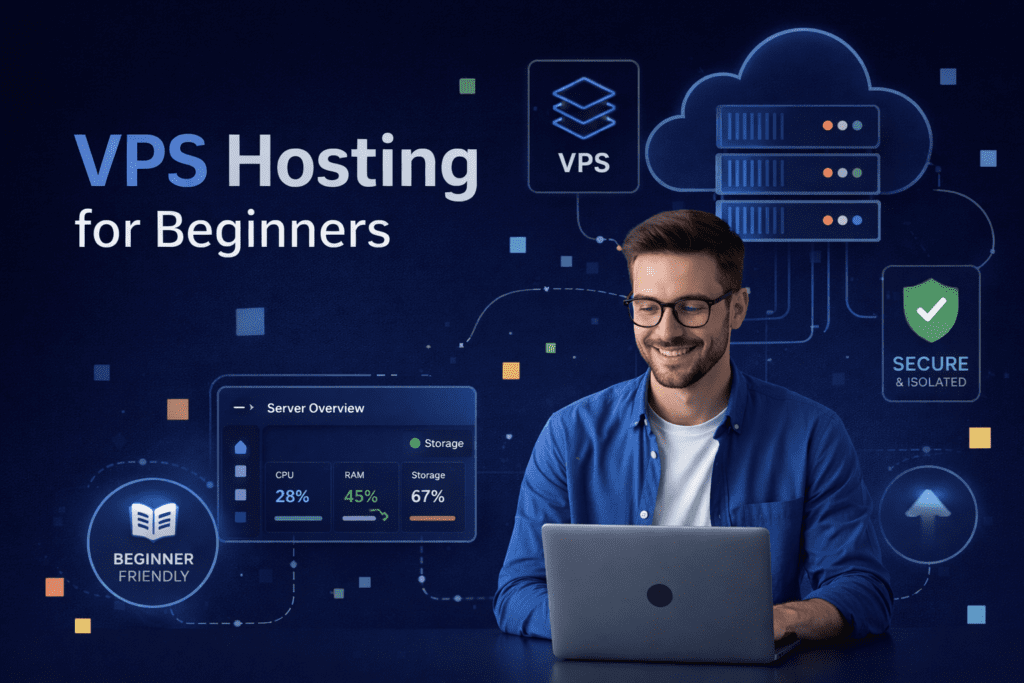
Cryptocurrency projects rely on more than blockchain technology and digital assets. Behind many crypto applications is a server infrastructure responsible for hosting websites, running software, processing data, connecting applications to blockchain networks, and keeping services available around the clock.
For beginners, choosing the right hosting environment can seem complicated. Terms such as VPS, cloud server, dedicated server, blockchain node, RAM, bandwidth, and storage can make the process confusing.
A Virtual Private Server, or VPS, is one of the most accessible options for cryptocurrency projects. It provides a private virtual environment with configurable resources and greater control than traditional shared hosting.
This guide explains what VPS hosting is, how it can be used for cryptocurrency projects, and what beginners should consider before choosing a server.
What Is VPS Hosting?
VPS hosting uses virtualization technology to divide physical server resources into separate virtual environments. Each VPS operates with its own operating system and can be managed independently.
Unlike shared hosting, where customers generally share the same hosting environment and have limited server-level control, a VPS gives users much more freedom to install software and configure services.
A typical VPS may include:
- Virtual CPU resources
- RAM
- SSD or NVMe storage
- Network bandwidth
- A dedicated IP address
- An operating system
- Administrative or root access
The exact specifications depend on the hosting provider and selected plan.
For cryptocurrency projects, this flexibility can be especially useful because different applications have different technical requirements.
Why Do Cryptocurrency Projects Use VPS Hosting?
Cryptocurrency projects can involve many different types of applications.
A developer might need a server to host a Web3 application, while another user may want to operate a blockchain node. A Crypto VPS business might simply need reliable infrastructure for its website or API.
VPS hosting can support many of these use cases.
Common examples include:
- Blockchain nodes
- Cryptocurrency websites
- Web3 applications
- Blockchain APIs
- Trading applications
- Analytics dashboards
- Development environments
- Monitoring software
- Databases
- Automation tools
The important thing is to choose the VPS configuration according to the application rather than assuming that every crypto project requires an expensive server.
VPS vs. Shared Hosting
Beginners may wonder why they should choose a VPS instead of ordinary shared hosting.
Shared hosting is designed primarily for websites. It is inexpensive and relatively easy to use, but users typically have limited access to server-level settings.
A VPS provides a more independent environment. Users can generally install their preferred software, configure services, manage security settings, and access the server remotely.
This makes a VPS more suitable for applications that require customized server configurations.
For a simple cryptocurrency blog, shared hosting may be sufficient. For a blockchain application requiring custom software, a VPS can provide much greater flexibility.
VPS vs. Dedicated Servers
A dedicated server gives one customer access to an entire physical server.
This can provide substantial computing resources and predictable hardware performance, but dedicated servers are usually more expensive and may be unnecessary for smaller projects.
A VPS offers a middle ground.
It can provide:
- Lower initial costs
- Faster deployment
- Flexible configurations
- Administrative control
- Easier resource upgrades
A beginner can therefore start with a VPS and move to dedicated infrastructure later if the project eventually requires additional resources.
Understanding VPS Resources
One of the most important parts of choosing a VPS is understanding its specifications.
CPU
CPU resources determine how much processing capacity the server has.
A basic website may require very little CPU power, while blockchain analytics, databases, and computational applications can need considerably more.
RAM
RAM is used by applications while they are running.
Web servers, databases, blockchain software, and multiple applications running simultaneously may require additional memory.
If a server frequently runs out of memory, applications can become slow or stop working properly.
Storage
Storage is particularly important for blockchain projects.
Some applications require only a few gigabytes, while blockchain nodes can require hundreds of gigabytes or more.
Bitcoin Core, for example, currently requires substantial storage for a full blockchain copy. Bitcoin.org states that the full blockchain is over 740 GB and explains that pruning can reduce local storage requirements to about 7 GB.
Therefore, always determine the storage requirements of your specific blockchain software before purchasing a VPS.
Bandwidth
Bandwidth refers to the amount of data the server can transfer.
Blockchain nodes can consume significant network resources because they communicate with other nodes and synchronize blockchain data.
Bitcoin.org notes that a full node can use significant upload bandwidth, making an appropriate network plan important for anyone operating one.
What Can You Run on a Crypto VPS?
A VPS can support many types of cryptocurrency-related software.
Blockchain Nodes
A blockchain node connects to a blockchain network and performs functions defined by the relevant software.
Bitcoin Core full nodes independently validate blocks and transactions according to Bitcoin’s consensus rules.
Running a node on a VPS can be convenient because the server can remain online without requiring a personal computer to operate continuously.
However, node requirements vary between blockchain networks, so research the specific software before selecting a plan.
Web3 Applications
Developers can use a VPS to host the backend components of decentralized applications.
These may include APIs, databases, authentication services, dashboards, and other application components that interact with blockchain networks.
Cryptocurrency Websites
Not every crypto project needs a blockchain node.
A cryptocurrency news website, educational platform, community site, or business website may require only standard web hosting resources.
A VPS can provide more control than shared hosting while remaining relatively affordable.
Development and Testing
Developers can also use VPS hosting as a remote development or staging environment.
This allows them to test applications on a server that resembles the environment used for production.
Choosing Linux or Windows
Most server applications are commonly deployed on Linux because of its broad software support, command-line tools, and popularity among developers.
Linux distributions such as Ubuntu and Debian are frequently used for web and blockchain infrastructure.
Windows VPS hosting can also be useful when an application specifically requires Windows software or tools.
The correct choice depends on the software you plan to install.
Security Basics for Beginners
A VPS gives you more control, but it also gives you more responsibility.
Once you have access to a server, you should take basic steps to protect it.
Use Strong Authentication
Use strong passwords and, where supported, SSH keys. Avoid leaving unnecessary administrative access exposed to the internet.
Configure a Firewall
A firewall can restrict incoming connections to only the services that need to be publicly accessible.
Keep Software Updated
Regularly update the operating system, server applications, databases, and blockchain software.
Outdated software can contain security vulnerabilities.
Monitor Your Server
Monitoring CPU, RAM, storage, and network activity can help identify unusual behavior or resource problems.
VPS Hosting Does Not Replace Wallet Security
This is especially important for cryptocurrency beginners.
A VPS can host cryptocurrency software, but it should not automatically be considered a secure place to store large amounts of cryptocurrency.
Internet-connected computers can be targeted by malware and unauthorized access. Bitcoin.org specifically warns that users are responsible for securing their wallets and recommends cold storage for significant amounts of bitcoin.
A sensible approach is to separate infrastructure from long-term asset storage. Use the VPS for applications, services, nodes, or other computing tasks while using appropriate security measures for cryptocurrency custody.
How Much VPS Power Do You Need?
There is no universal answer.
A small cryptocurrency website might work well with a basic VPS. A development environment may need moderate CPU and RAM. A blockchain node may require substantial storage and bandwidth.
Start by identifying:
- Which software you will run
- How much storage it requires
- How much RAM it recommends
- How much CPU it needs
- How much network traffic it generates
- Whether the workload runs continuously
- Whether the application is expected to grow
This approach helps prevent both under-provisioning and unnecessary spending.
Consider Scalability
Your first VPS does not have to be your final server.
A new cryptocurrency project may start with a small number of users and modest resource requirements. As traffic increases, the project may need more CPU, RAM, storage, or bandwidth.
Before choosing a provider, check whether you can upgrade your VPS easily.
Scalability can be particularly useful for startups because it allows infrastructure to grow alongside the application.
Location Can Affect Performance
The physical location of the VPS data center can affect network latency.
If most users are located in Europe, hosting the application closer to Europe may provide better response times. The same principle applies to applications serving customers in Asia, North America, or other regions.
For blockchain applications, location can also influence connectivity to APIs, exchanges, users, and other services.
Choosing a location close to the most important users and services can therefore be a useful performance consideration.
Understanding VPS Pricing
VPS prices can vary significantly.
When comparing plans, do not look only at the advertised monthly price. Check what is actually included.
Consider:
- CPU allocation
- RAM
- Storage capacity
- Storage type
- Bandwidth
- IP addresses
- Backup options
- DDoS protection
- Data center locations
- Operating system options
- Upgrade costs
- Billing method
Some providers use monthly billing, while cloud-focused services may also offer hourly or usage-based billing.
The cheapest VPS is not necessarily the best choice if it lacks the resources your application requires.
A Simple Beginner Checklist
Before purchasing VPS hosting for a cryptocurrency project, ask yourself:
What am I hosting?
Determine whether you need a website, blockchain node, Web3 application, API, database, or another service.
How much storage do I need?
Check the software’s current requirements and allow room for future growth.
How much RAM and CPU are required?
Review official documentation whenever possible.
How much bandwidth will I use?
This is especially important for blockchain nodes.
Do I need Linux or Windows?
Choose the operating system supported by your application.
Can I upgrade later?
A scalable VPS can make future growth easier.
What security controls are available?
Look for useful infrastructure features, but remember that server security remains partly your responsibility.
Does the provider permit my workload?
Always review the provider’s acceptable-use and service policies.
Final Thoughts
VPS hosting can be an excellent starting point for cryptocurrency projects because it combines flexibility, control, and relatively accessible infrastructure.
Beginners can use a VPS for websites, development environments, APIs, Web3 applications, blockchain monitoring, and—in suitable configurations—blockchain nodes.
The most important step is understanding your workload before selecting a plan. CPU, RAM, storage, bandwidth, operating system, location, security, and scalability all influence whether a VPS will perform well.
For blockchain-specific applications, requirements can be considerably higher than those of an ordinary website. Bitcoin Core’s official documentation, for example, highlights substantial storage and bandwidth considerations for full nodes.
Start with the requirements of your software, choose a VPS with enough room to operate comfortably, and build security into the setup from the beginning. With that approach, VPS hosting can provide a dependable foundation for experimenting with and growing cryptocurrency projects.