

The rapid growth of digital commerce has revolutionized the way people shop, bank, and conduct business online. Every day, millions of financial transactions take place through websites, mobile applications, and digital payment platforms. prozone cc While these technologies provide convenience and efficiency, they have also created opportunities for cybercriminals to exploit sensitive financial information.
The dark web has gained significant attention because some anonymous platforms have been associated with the exchange of stolen data, fraudulent services, and other forms of cybercrime. References to Prozone CC have appeared in discussions related to payment card fraud and stolen financial information. Rather than focusing on any particular platform or promoting illegal activities, examining these discussions offers valuable lessons about the broader risks of cybercrime, data theft, and financial fraud.
Understanding how cybercriminal networks operate at a high level can help individuals, businesses, and financial institutions strengthen their defenses. This article explores the dark web economy, the impact of payment card fraud, and the cybersecurity measures that help protect sensitive financial information.
Understanding the Dark Web
The internet is commonly divided into three sections:
- Surface Web
- Deep Web
- Dark Web
The surface web includes websites indexed by search engines, such as news websites, online stores, blogs, and social media platforms.
The deep web contains content that is not indexed by search engines, including online banking portals, medical records, cloud storage, private databases, and subscription services.
The dark web is a small portion of the deep web that requires specialized software or configurations to access. It was originally developed to support anonymous communication and protect user privacy. While it has legitimate uses for journalists, researchers, and people living under restrictive environments, it has also been misused by criminals seeking anonymity.
Understanding this distinction is important because the dark web itself is simply a technology. Its impact depends on how it is used.
The Dark Web Economy
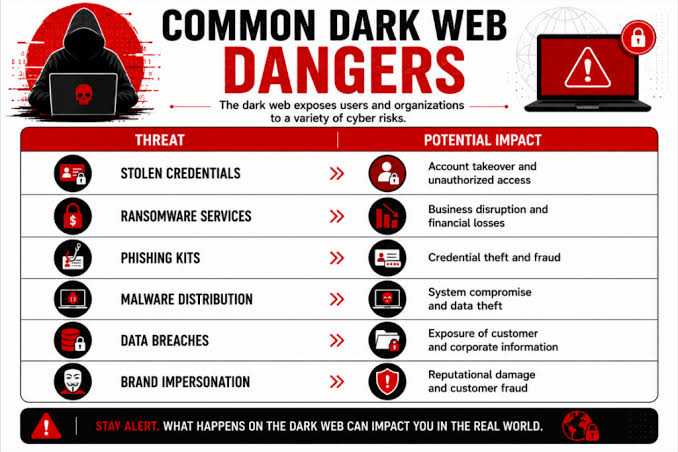
The term “dark web economy” refers to the collection of anonymous online communities and marketplaces where digital goods, services, and information may be exchanged. While some activities are legal and privacy-focused, law enforcement agencies have identified criminal networks that misuse these environments for illegal purposes.
These criminal ecosystems may involve:
- Stolen personal information
- Compromised account credentials
- Fraud-related discussions
- Malware distribution
- Phishing resources
- Money laundering schemes
The existence of these activities highlights the importance of cybersecurity awareness rather than curiosity about illicit marketplaces.
Payment Card Fraud as a Cybersecurity Challenge
Payment card fraud remains one of the most significant financial cybercrime threats worldwide.
Fraud occurs when criminals obtain payment card information and use it without the cardholder’s authorization. Victims may experience unauthorized purchases, account disruptions, identity theft, and financial losses.
Common forms of payment card fraud include:
- Unauthorized online purchases
- Counterfeit payment cards
- Account takeover
- Identity theft involving financial information
- Card-not-present (CNP) fraud
As digital payments become more common, organizations continue investing in stronger security technologies to combat these threats.
How Payment Information Becomes Compromised
Cybercriminals often obtain financial information by exploiting security weaknesses rather than attacking payment systems directly.
Common causes include:
Phishing Attacks
Fraudulent emails, text messages, or fake websites attempt to trick users into revealing payment information or account credentials.
Data Breaches
Organizations that fail to properly secure customer information may expose payment data during cyberattacks.
Malware
Malicious software can capture sensitive information from infected devices, including stored passwords and payment details.
Weak Passwords
Using the same password across multiple accounts increases the risk that one compromised account could lead to unauthorized access elsewhere.
These attack methods demonstrate why cybersecurity requires both technical controls and responsible user behavior.
Privacy Risks of Stolen Financial Information
When payment information is compromised, the consequences often extend beyond unauthorized purchases.
Potential privacy risks include:
- Identity theft
- Account compromise
- Financial fraud
- Loss of personal information
- Targeted phishing campaigns
Criminals may combine financial information with other personal data to build detailed profiles of victims, making future scams more convincing.
Protecting personal information therefore plays a key role in reducing overall cybersecurity risk.
The Importance of Cybersecurity Awareness
One of the strongest defenses against cybercrime is education.
Cybersecurity awareness helps individuals recognize common warning signs before becoming victims.
Important habits include:
- Verifying website addresses
- Identifying phishing attempts
- Using secure passwords
- Protecting confidential information
- Reporting suspicious activity
Well-informed users are significantly less likely to fall victim to common online scams.
Technologies That Protect Online Payments
Modern payment systems use multiple layers of security to reduce fraud and protect customer information.
Encryption
Encryption converts readable payment information into coded data during transmission.
Sensitive information such as card numbers and billing details remains unreadable without authorized decryption keys.
Tokenization
Tokenization replaces actual payment card numbers with randomly generated digital tokens.
Even if attackers obtain these tokens, they cannot be used outside the authorized payment system.
Multi-Factor Authentication
Multi-Factor Authentication (MFA) requires users to provide an additional verification factor beyond a password.
Examples include:
- Authentication apps
- One-time verification codes
- Fingerprint recognition
- Facial recognition
This additional layer greatly reduces unauthorized account access.
Artificial Intelligence
Financial institutions increasingly rely on artificial intelligence to identify unusual transaction patterns and detect potential fraud in real time.
AI systems continuously analyze customer behavior while reducing false alarms.
Business Responsibilities
Organizations that process customer payments have significant cybersecurity responsibilities.
Key security practices include:
PCI DSS Compliance
The Payment Card Industry Data Security Standard (PCI DSS) provides security requirements for protecting payment card information.
Compliance includes:
- Encrypting payment data
- Restricting system access
- Monitoring network activity
- Conducting security assessments
- Maintaining secure infrastructure
Employee Training
Human error remains one of the leading causes of cybersecurity incidents.
Organizations should provide regular employee training covering:
- Phishing awareness
- Password security
- Secure handling of customer information
- Incident reporting
Educated employees strengthen an organization’s overall security posture.
Continuous Monitoring
Security monitoring tools help identify suspicious behavior before significant damage occurs.
Organizations should monitor:
- Login activity
- Payment transactions
- Network traffic
- User behavior
- Potential malware infections
Early detection allows faster incident response and limits potential losses.
Consumer Best Practices
Individuals can significantly reduce their exposure to payment fraud by adopting safe online habits.
Recommended practices include:
- Using strong, unique passwords
- Enabling Multi-Factor Authentication
- Keeping software updated
- Monitoring financial statements regularly
- Shopping only on trusted websites
- Avoiding suspicious emails and messages
- Reporting unauthorized transactions immediately
These simple actions provide meaningful protection against many common cyber threats.
The Future of Payment Security
As digital commerce continues expanding, payment security technologies continue evolving.
Emerging innovations include:
- Behavioral analytics
- Passwordless authentication
- Advanced biometric verification
- Artificial intelligence-powered fraud detection
- Zero Trust security frameworks
- Enhanced encryption technologies
These solutions aim to improve security while maintaining convenient user experiences for consumers and businesses alike.
The ongoing development of defensive technologies demonstrates that cybersecurity is a constantly evolving field requiring continuous improvement.
Conclusion
Discussions surrounding Prozone CC and similar names illustrate a larger cybersecurity issue rather than defining the digital payment landscape. The real concern is the ongoing challenge of protecting sensitive financial information from theft, misuse, prozone.st and fraud. Criminal networks that exploit stolen data underscore the importance of strong cybersecurity practices, effective law enforcement efforts, and public awareness.
Individuals can reduce their risk by using strong passwords, enabling Multi-Factor Authentication, keeping devices updated, monitoring financial accounts, and remaining cautious of phishing attempts. Businesses must complement these efforts with encryption, tokenization, PCI DSS compliance, employee training, and continuous security monitoring.
As the digital economy continues to grow, protecting payment information will remain a shared responsibility. Through education, responsible online behavior, and modern cybersecurity technologies, consumers and organizations can help create a safer digital environment while reducing the impact of payment card fraud and other forms of cybercrime.